VON SCHELLENDORF, Ingeborg Bronsart
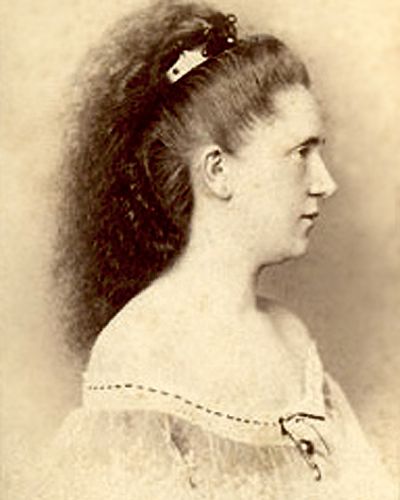
Ingeborg Starck was born in Saint Petersburg, the daughter of Finland-Swedish parents Margareta Åkerman and Otto Starck who were living in Saint Petersburg, Russia, where her father, a court saddle-maker, was involved in commerce. Her native language was Swedish. Having shown musical gifts from a young age, she studied piano with Nicolas von Martinoff and Adolf Henselt, as well as composition with Konstantin Decker. She completed her studies in Weimar with Franz Liszt. During a stay in Paris in 1861 her friends included composers such as Auber, Berlioz, Rossini and Wagner. In September of the same year, she married fellow pianist-composer Hans Bronsart von Schellendorff, a member of Liszt's circle whom she had met in Weimar.
Ingeborg Bronsart von Schellendorf toured Europe as a concert pianist until 1867, when her husband accepted a court appointment at the Royal Theatre in Hanover; state policy prohibited the wives of Prussian officials from appearing publicly as artists. She remained musically active as a composer of vocal music, notably four operas and approximately eighty art songs,[5] chamber and instrumental music. Her songs set texts by poets of the golden age of German Romanticism, including Goethe, Rückert, and Heine, as well as by several of her contemporaries, among them Friedrich von Bodenstedt, Peter Cornelius, and Ernst von Wildenbruch. Earlier, she had composed a piano concerto (1863), now lost. During her lifetime her operas were successfully produced in many theatres in Germany. Pieces composed by her which were popular at the time included her Kaiser Wilhelm March (1871), the Singspiel Jery und Bätely (1873) and the opera Hiarne (1891). Marie Lipsius, her friend and biographer, described her as "the first and until now the only German woman dramatic composer," and also noted that she was also "the first woman to have brought a large opera {Hiarne) to the stage. Despite Hiarne's success, it was never published. Her first opera, Die Göttin von Sais was lost, despite its surviving libretto. Other works experienced success: her sole large orchestral work, Kaiser-Wilhelm March composed in 1871, was written to celebrate the triumphant return of German troops to Berlin following the Franco-Prussian War. The work was later performed at the opening of the Women’s Section of the World’s Fair in Chicago in 1893. She died in Munich.
References
The Big List is a free resource, but it's not free to build. Support the Donne Foundation and help us keep it growing.
Footer