
BLOMQVIST, Anna
The Big List is a free resource, but it's not free to build. Support the Donne Foundation and help us keep it growing.
Footer


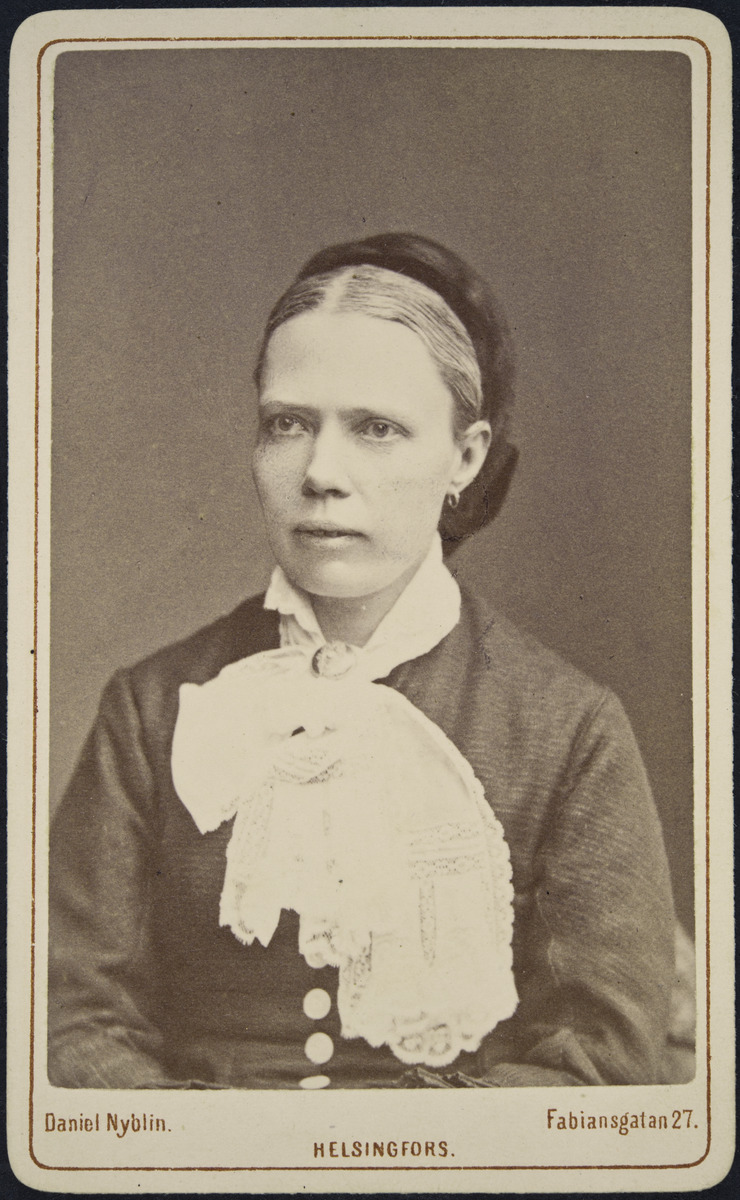
Anna Catharina Blomqvist was a Finnish voice teacher, choir conductor, composer, and women's rights activist. She was a pivotal, yet often secondary, figure in the development of the late 19th-century Finnish musical landscape, championing both women's education and classical vocal arts. Born in Helsinki, Finland, she was the daughter of Alexander Blomqvist, a professor of literature, and Christina Charlotta Harring. Her sister, Anna Charlotta Elisabeth Blomqvist, would also become a prominent educator. Anna was deeply educated, traveling extensively across Europe to study languages and music in France and Switzerland (1856–1858), Dresden, Berlin, and Paris (1867–1869), and returning to Berlin for language studies in 1877. Blomqvist initially aspired to be a professional singer, performing as a soloist in major choral and church works conducted by Fredrik Pacius, Filip von Schantz, and Richard Faltin. However, her memoirs and historical records indicate that performance anxiety, paired with the systemic boundary blurring and harassment faced by female musicians at the time, led her to redirect her career toward teaching and organizing behind the scenes. Despite her rigorous musical credentials, she was passed over for permanent, full-time vocal professor positions in favor of male peers. Instead, she built a highly impactful 40-year career as a language and vocal teacher.
Blomqvist was a crucial instigator in building Helsinki's early musical infrastructure. She helped conceptualize the beginnings of what would become the Helsinki Music Institute (now the Sibelius Academy) and played an active role in founding the Helsinki Singing Association (1871) and the Helsinki Dilettante Association (1874–1881). As a composer, Blomqvist focused primarily on solo songs, choral works, and chamber music. Because of the social boundaries placed on women creators during her lifetime, her works—such as her 1868 setting of J. L. Runeberg's poem "I en ung flickan minnesbok"—were largely performed in private salons and within the network of her girls' school rather than on public orchestral stages.
The Big List is a free resource, but it's not free to build. Support the Donne Foundation and help us keep it growing.